1X2 Fixed Matches and Football Result Predictions
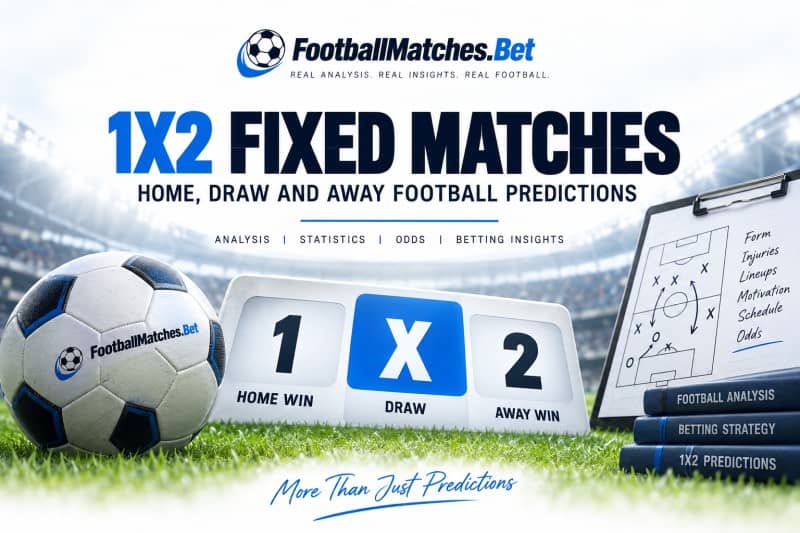
1X2 is one of the best-known and simplest markets in football betting. At first glance, the choice looks straightforward. The number 1 represents a home win, X represents a draw, while 2 represents an away win.
Still, having only three possible selections does not make the right assessment simple. Different factors can directly affect the final result of every match.
Team form, home and away records, injuries, suspensions, expected lineups, the schedule and the importance of the match all deserve attention. In addition, the odds can show how the market assesses the probability of each possible outcome.
For this reason, a serious 1X2 analysis should not focus only on the favourite or the team with the better league position. FootballMatches.Bet approaches the term 1X2 Fixed Matches from this perspective.
How We Approach 1X2 Football Predictions
The phrase “Fixed Matches” forms part of the marketing terminology used on FootballMatches.Bet. It also reflects the way users search for this type of football prediction content. Its use in the title does not mean that matches are manipulated, that the final result is known in advance or that FootballMatches.Bet has access to illegal match-fixing information.
FootballMatches.Bet does not organize, facilitate, encourage or sell information related to football match-fixing. We prepare our predictions and analyses using available football information, statistics, form, lineups, injuries, suspensions, schedules, odds and other relevant factors.
Therefore, the words “Fixed Matches” should be viewed within the terminology of the website. They do not represent a claim that the outcome of a particular match has been predetermined.
The same principle applies to 1X2 predictions. No analysis can remove uncertainty from football. A red card, penalty, injury, individual mistake or late goal can completely change a match.
For that reason, the purpose of the analysis is not to create the impression of a guaranteed outcome. Instead, it helps assess the three basic possibilities more carefully: a home win, a draw or an away win.
The following sections look at how the 1X2 market works, what 1, X and 2 represent, and which factors can help when assessing the final result. We will also look at the role of 1X2 odds in the analysis and why the favourite is not automatically the best selection.
What Does 1X2 Fixed Matches Mean in Football Betting?
The 1X2 market focuses on the final result of a football match. Unlike markets based on goals, score changes or a specific period of the game, 1X2 offers three basic options: a home win, a draw or an away win.
This differs from an HT FT Betting Tip, where both the halftime and fulltime outcomes form part of the prediction.
The number 1 represents a home win. For example, if Arsenal plays Chelsea at home and the match ends 2–1, selection 1 wins. It does not matter whether the home team wins by one goal or by a larger margin. Only the final outcome matters in the 1X2 market.
The X represents a draw. In this case, both teams must finish the match with the same number of goals. Results such as 0–0, 1–1, 2–2 or 3–3 all have the same meaning for this market. Each result represents X.
The number 2 represents an away win. If the visiting team wins 0–1, 1–2 or by any other score in its favour, selection 2 wins.
The Final Result Is the Basis of 1X2 Fixed Matches
In the standard 1X2 market, bets usually apply to the result after the regular 90 minutes, including added time. Extra time and penalties in cup matches are usually not part of a standard 1X2 bet unless the bookmaker states different rules.
Therefore, bettors should always check the terms of the specific operator before placing a bet. This distinction becomes particularly important in knockout matches.
For example, a team may qualify for the next round after extra time or penalties. Still, the 1X2 selection can remain X if the score was level at the end of regular time.
A Simple Market Does Not Mean a Simple Prediction
The three possible outcomes make 1X2 easy to follow, but they do not make the final result easy to assess. For example, a team that looks stronger in the league table may have a poor away record. Another team may play at home but enter the match without several key players.
In some situations, a draw may be a more realistic option than a win for the favourite. For this reason, the analysis should go beyond one simple question: Which team is better? Instead, the aim is to assess which of the three outcomes has the strongest support from the available pre-match information.
At FootballMatches.Bet, 1X2 is one of the markets that we may use when preparing selections, including those provided through the Daily Fixed Matches subscription. Still, our daily selections are not limited to 1X2.
When the analysis points to a more suitable market, other options may also be used, such as Over 2.5 or Over 3.5 Goals. Each market requires a different approach. Therefore, this article remains focused specifically on 1X2 and the assessment of the final match result.
What Factors Matter When Analyzing a 1X2 Match?
Although 1X2 offers only three possible outcomes, choosing between 1, X and 2 requires a broader match analysis. One piece of information is rarely enough to support a solid assessment.
Instead, several factors should be compared to see whether they point in the same direction or lead to different conclusions.
Home and away form is a good starting point. A team may have strong overall results while collecting most of its points at home. On the other hand, the opponent may struggle in away matches. In that situation, the league table alone does not show the full picture.
Recent results also matter, but they need context. Five consecutive wins may look impressive, but the level of opposition is important. Victories against teams near the bottom of the table may not carry the same weight as strong results against direct rivals.
Injuries, suspensions and expected lineups can also change the assessment. The absence of a first-choice goalkeeper, leading striker or several important midfielders may have a significant effect on the team’s performance.
For this reason, lineup information should be checked as close to kick-off as possible.
Motivation and Schedule Can Change the Picture
Not every match carries the same importance for both teams. One side may be fighting for the title, a European place or survival, while the other may have little room to change its league position.
Still, motivation should not automatically lead to a 1 or 2 selection. It is another factor that needs to be considered alongside the rest of the available information.
The schedule also deserves attention. A team that played a demanding European match a few days earlier may rotate players or show signs of fatigue. Meanwhile, an opponent with a full week to prepare may enter the match in better physical condition.
Odds provide additional context because they show how the market values the three possible outcomes. Still, the lowest odds do not prove that the favourite will win.
Football remains unpredictable. Therefore, odds should form part of the analysis rather than replace it.
Practical Example of 1X2 Analysis
Consider a hypothetical match where the home team has odds of 1.85 to win, the draw is priced at 3.50 and the away win at 4.20. The odds make the home team the favourite, but that alone is not enough to automatically select 1.
Suppose the home side has won five of its last six matches at home, can field its strongest lineup and has a strong reason to fight for all three points. In that case, selection 1 receives additional support.
The same match could also be assessed through Both Teams to Score Fixed Matches if the attacking and defensive records suggest that both sides have a realistic chance of scoring.
At the same time, the visitors may have a poor away record and could enter the match without two important players. Several independent factors would then start pointing in the same direction.
Still, the assessment would look different if the home favourite had just played a demanding match, had several players unavailable and regularly dropped points against defensive teams. In such a situation, the lower odds for 1 should not be enough to ignore the possibility of X or 2.
That is the main principle behind a solid 1X2 analysis. We do not look for one statistic that can “prove” the final result. Instead, we check whether several relevant factors support the same assessment.
The History of 1X2 in Football Betting
Today, the symbols 1, X and 2 seem like a natural part of football betting. Still, the system has its own history and developed alongside different forms of football result prediction.
Attempts to predict football results are much older than modern bookmakers. Documented football prediction competitions date back to 1887. In Britain, football pools also developed significantly during the 1920s. Littlewoods Football Pool, which later became extremely popular, started in 1923.
Still, the familiar 1X2 notation that we know today has its own story. According to historical material from Sisal, Italian sports journalist Massimo Della Pergola developed the idea of using three symbols for match outcomes.
At first, he considered using ABC and later 123. Eventually, he chose the combination 1X2. In this system, 1 represented a win for the first or home team, X represented a draw, while 2 represented a win for the second or away team.
A historical example can be found on the first Totocalcio ticket from 1947. It used these three symbols to predict the outcomes of football matches.
The simplicity of the system is one reason why 1X2 became so recognizable. Instead of predicting the exact score, bettors only need to assess one of three basic outcomes: a home win, a draw or an away win.
Over time, 1X2 became a standard way to represent the final-result market and is now used by football bookmakers around the world.
Although match analysis has developed considerably, the basic idea behind 1X2 remains the same. Statistics, form, lineups, injuries and odds provide far more information for analysis today. Still, the final selection comes down to the same three symbols: 1, X or 2.
1X2 Fixed Matches and the Right Approach to Analysis
As football betting developed, 1X2 became one of the most recognizable ways to assess the final outcome of a match. The basic symbols have remained the same: 1 for a home win, X for a draw and 2 for an away win.
What has changed significantly is the amount of information available before a match. A solid assessment combines several relevant factors instead of relying only on the favourite, the league position or a single statistic.
Still, even detailed analysis cannot determine the final result in advance. Uncertainty remains an essential part of football.
For this reason, when FootballMatches.Bet uses the term 1X2 Fixed Matches, it refers to the terminology used for our football analysis and predictions. It does not claim that a particular match is manipulated or that its outcome is known in advance.
The purpose of 1X2 analysis is much simpler. It brings together relevant information, assesses the three possible outcomes and uses those factors to make an informed choice between 1, X and 2.
